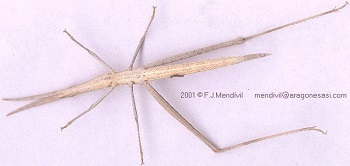
To proceed with the description of what an insect looks like, a stick insect photographed in Zaragoza is shown here.
| The body of the insect is protected by the exoskeleton, or external skeleton, almost always rigid and, in some cases, very thick. | ||
The body is divided into the head, thorax, and abdomen, with a diverse number of segments. | ||
| Abdomen | Tórax | Cabeza |
|---|---|---|
| ||
Son Artropods, that is, with articulated appendages. | ||

External elements of an Insect
Antennas
Insects have several sensory organs on their antennae that collect sensations of touch, humidity, temperature and sound.
And they are also sensitive to smell and taste.
The shape is very varied according to each species of insects.
Different types of antennae of an insect:
- Gatherer (bee).
- Presser (Louse).
- Slider (mosquito).
- Excavator (Mole Cricket).
- Sensitive plaque.
- Sensitive filament.
Legs
| All insects have six legs with the same elements, but with notable differences, adapted to the way of life of each species. | ||
| Coxa y Trocánter | Fémur | Tibia y Tarso. |
|---|---|---|
| ||

Some types of insect legs are as follows:
- Jumper (grasshopper).
- Swimmer (ditisco).
- Walker (wasp).
- Of prey (mantis).
The wings
Some insects lack wings, but most have two or four wings located on the thorax.
Flight movements are produced by the action of longitudinal and transverse muscular bands of the thorax.
The wings can have multiple shapes, colors and sizes.
Some insects have the first pair transformed into protective hard elytra.
Number of wings an insect can have:
- Two wings.
- Four wings.
- No wings.
Inside of insects
They have a circulatory system with a dorsal heart and ostioles.
And a respiratory system through tracheas.
The tracheas open to the outside through holes or stigmas and branch throughout the body of the insect.
The nervous and sensory system is very complex.
More information about insects
A small presentation of the diversity of the insects could be the following:
| WITHOUT WINGS or Apteros | |
|---|---|
| Proturos | They are the most primitive insects. Without wings or antennae. |
| Colembolos | Sin alas. A ventral organ allows them to take great leaps. |
| Tisanuros | Tres apendices terminales Lepisma or silverfish |
| Dipluros | Two terminal appendices. |
| WITH WINGS | |
| Ephemeroptera | Rudimentary mouthpieces. Two pairs of wings. Aquatic larvae with gills. Ephemeral |
| Plecoptera | Incomplete metamorphosis Aploembia |
| Odonates | Chewing mouth. Two pairs of large membranous wings. Aquatic larvae. Libelulas |
| Mantoids or mantids | Incomplete metamorphosis Mantis religiosa |
| Blactereos | Mouthpiece masticator Cockroach |
| Fasmideos | Mouthpiece masticator Insect stick |
| Dermapteros | Mouth chewing. Tongue at the end of the abdomen. Earwigs. |
| Orthotics | Mouth chewing. Two pairs of wings, of which the first protects the second. Cricket, Lobster |
| Isopters | Mouth chewing. Social organization similar to that of ants. Termes or Termites |
| Hemiptera | Superorder that includes heteropteros and homopteros. |
| Heteropteros | Mouthpieces choppers-suctors. Two pairs of wings, the first one in its anterior part. Bedbug. |
| Homopteros | Mouthpiece picador-suctor. Two pairs of equal wings, which sometimes are missing. Cicadas, aphids. |
| Hymenoptera | Mouthpieces chewing or sucking. Four membranous wings. Bee, Wasp, Ant |
| Malophagos | Chewing mouthpieces. Without wings. Places of birds and mammals. Lice of chickens. |
| Anopluros | Mouth filler-suctora. Without wings. Mammals' parts. Head louse. |
| Neuropteros | Chewing mouth. Four membranous wings with numerous nerviations. Lion ant. |
| Coleoptera | Chewing mouth pieces. Two pairs of wings, the first very coro form a protective case. Beetles, Fireflies. |
| Lepidoptera | Mouthpieces transformed into suctor apparatus that is spirally wound. Two pairs of membranous wings covered with scales. Butterflies and moths. |
| Diptera | Biting and sucking mouthpieces. Just a pair of wings. Fly, Mosquito, Tipula, Tabano |
The SEA is realizing a complete Catalog of the Aragonese Entomofauna that has already been partially published, where 190 families have been inventoried with 3012 species.
Other information about fauna in Aragón:
A small list of species in Aragon would be the following:
| Vertebrates | Invertebrates |
|---|---|
MammalsBirdsReptilesAmphibiansFishes |
MetazoansProtozoa |
|
images about the fauna in Aragon. photographs on invertebrates. beneficial animals for agriculture. | |
Also Aragon enjoys a diverse and varied Nature where passing by plants, animals, Geology, or landscapes we can arrive at a fantastic bestiary that lives in its monuments.
The information will not be complete without a stroll by its three provinces, with shutdown in some of its spectacular landscapes like Ordesa, the Moncayo, Monegros or by opposition the Ebro.
Also you can dedicarte to the intangible ones: from the legend compilation that also does to universal Aragon.